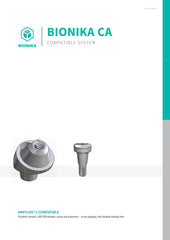
BIONIKA CA, Impression coping for open tray, multi-unit level, non-positioned
BIONIKA CA, Impression coping for open tray, multi-unit level, non-positioned
SKU:511.796.042.100UDI: 5993221349483 This product bears the CE mark – open the conformity information
Available to order (min. 10 pcs) · Production time: 3–5 working days
Length: L 10 mm
Couldn't load pickup availability
Brand characteristics
The BIONIKA CA implant system is a high-precision solution compatible with the Ankylos® C platform, featuring a conical connection that prioritises stability and long-term osseointegration.
Its conical, micromovement-free interface ensures optimal load distribution, reducing the risk of bone resorption and enhancing the durability of the implant–abutment connection.
The platform switching design promotes soft tissue sealing around the implant shoulder, creating a natural biological barrier.
The spirally micro-grooved thread provides strong cortical anchorage, while the self-locking, self-compressing spongiosa thread ensures excellent primary stability.
With its anatomical root shape, rounded apex, and precisely engineered geometry, the CA implant allows for minimally traumatic insertion, making it an ideal choice for clinical cases requiring high precision and long-term reliability.
Geometry characteristics
Version: narrow
Precision Impression Coping for Narrow Spaces – Open Tray Technique for Multi-Unit Systems
The Impression coping for open tray, multi-unit level, non-positioned, narrow is a specially designed impression component developed for multi-unit level systems, intended for use with the open tray technique. Its narrow design is particularly beneficial when space is limited or when components are placed close together.
The non-indexed design allows free rotation of the coping, simplifying placement when orientation is not a critical factor. The open tray method enables precise three-dimensional position transfer, especially in restorations involving multiple implants.
Main Advantages:
- Narrow design: Ideal for tight interproximal spaces and smaller-diameter multi-unit components.
- Multi-unit level fit: Direct connection to the system linking multiple implants.
- Open tray compatible: Direct screw retention allows accurate position registration and impression taking by removing the coping.
- Non-indexed configuration: Freely adjustable, allowing fast and flexible clinical application.
- Biocompatible material: Sterilisable, precisely manufactured, and durable.
Indications for Use:
The Impression coping for open tray, multi-unit level, non-positioned, narrow is an ideal choice for restorations involving multiple implants, especially under limited anatomical conditions where precise position transfer and clinical efficiency are key.
Version: wide
Stable open tray impression coping with wider diameter
The Impression coping for open tray, multi-unit level, non-positioned, wide is a prosthetic component designed for multi-unit systems and open tray impressions. Its wider design provides enhanced stability and better support for the impression material, especially in cases involving wider or longer-span restorations.
The non-indexed version allows for free rotation during insertion, simplifying the procedure in situations where precise orientation is not critical. The open tray technique offers accurate three-dimensional data on implant positioning, which is essential for precise laboratory fabrication.
Main advantages:
- Wide design: Greater stability within the impression material; ideal for multi-unit or full-arch restorations.
- Multi-unit level connection: Compatible with systems linking multiple implants.
- For open tray use: Direct screw-retained fixation ensures precise positioning and impression accuracy.
- Non-indexed design: Flexible insertion with free angulation based on clinical requirements.
- Biocompatible, durable material: Precisely machined and sterilizable construction.
Application:
The Impression coping for open tray, multi-unit level, non-positioned, wide is an excellent choice for full-arch or large-span restorations supported by multiple implants, where stable fit and accurate positional transfer are critical.
The product image is for illustration purposes only; colour and geometry may vary depending on selected dimensions.